
Ever wondered how to get rid of bindweed organically? Is there even such a thing as natural bindweed removal?
We have a world class collection of bindweed plants in our quarter-acre yard, so I’ve been on a mission to find ways to deal with it without using harmful chemicals.
Bindweed is one persistent and pugnacious plant, with many characteristics that make it tough to remove. For instance, its seeds can last up to 50 years!
Keep reading to learn how to get rid of bindweed, plus some fascinating facts — including one very redeeming quality about bindweed plants.
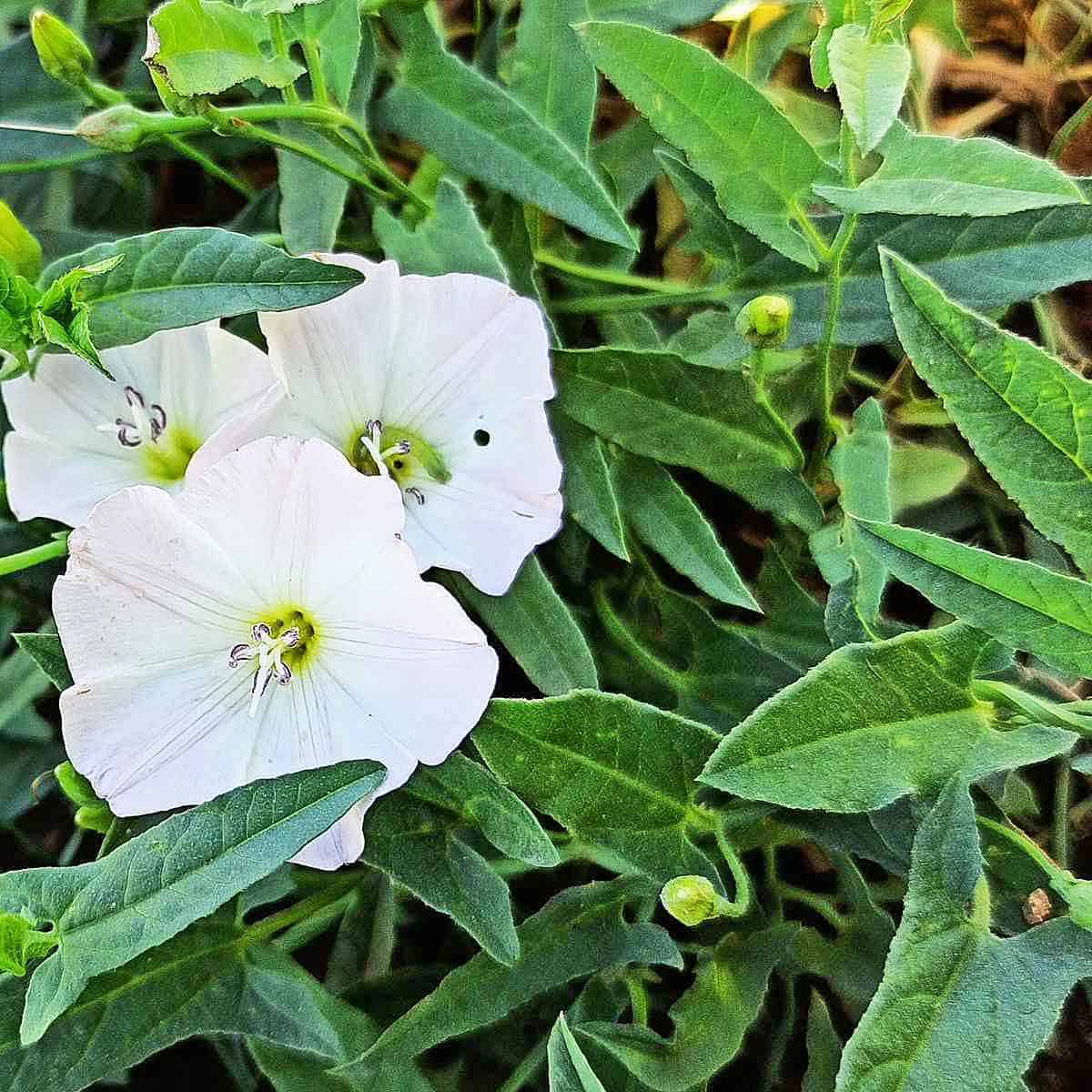
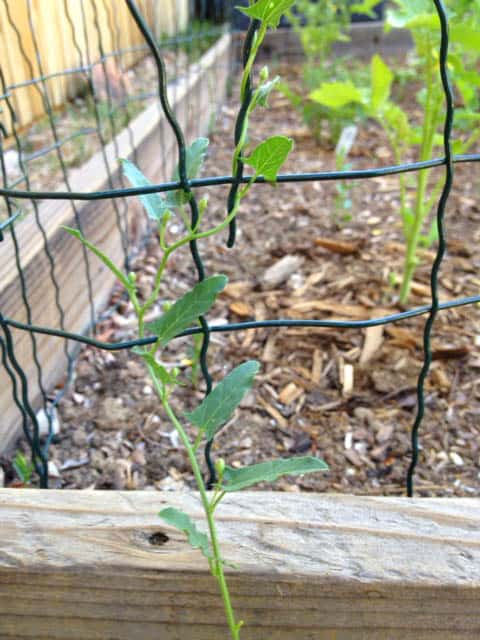
In our yard, the weed seems to especially enjoy growing in the vegetable gardens, but it also likes to twist its tendrils around the flowers and choke them when I’m not paying attention. It climbs up fences.
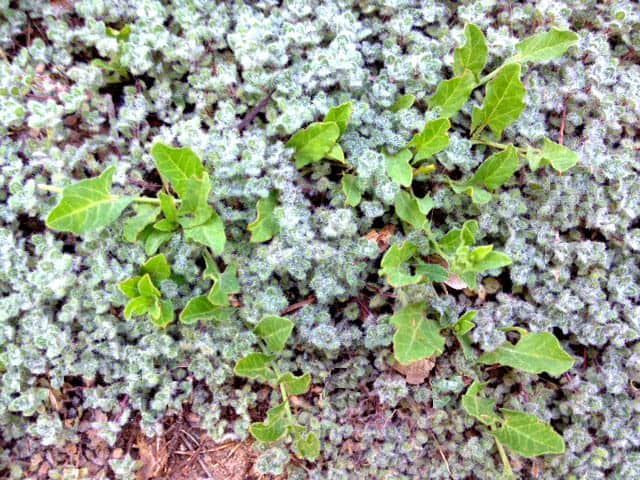
It grows up in the most inconvenient places, like smack in the middle of the creeping wooly thyme.
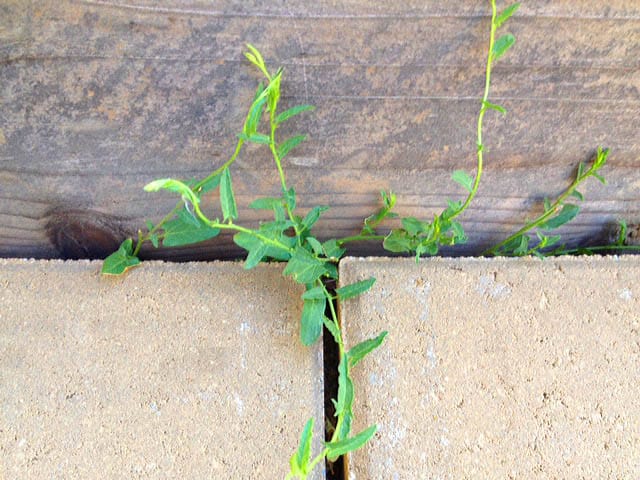
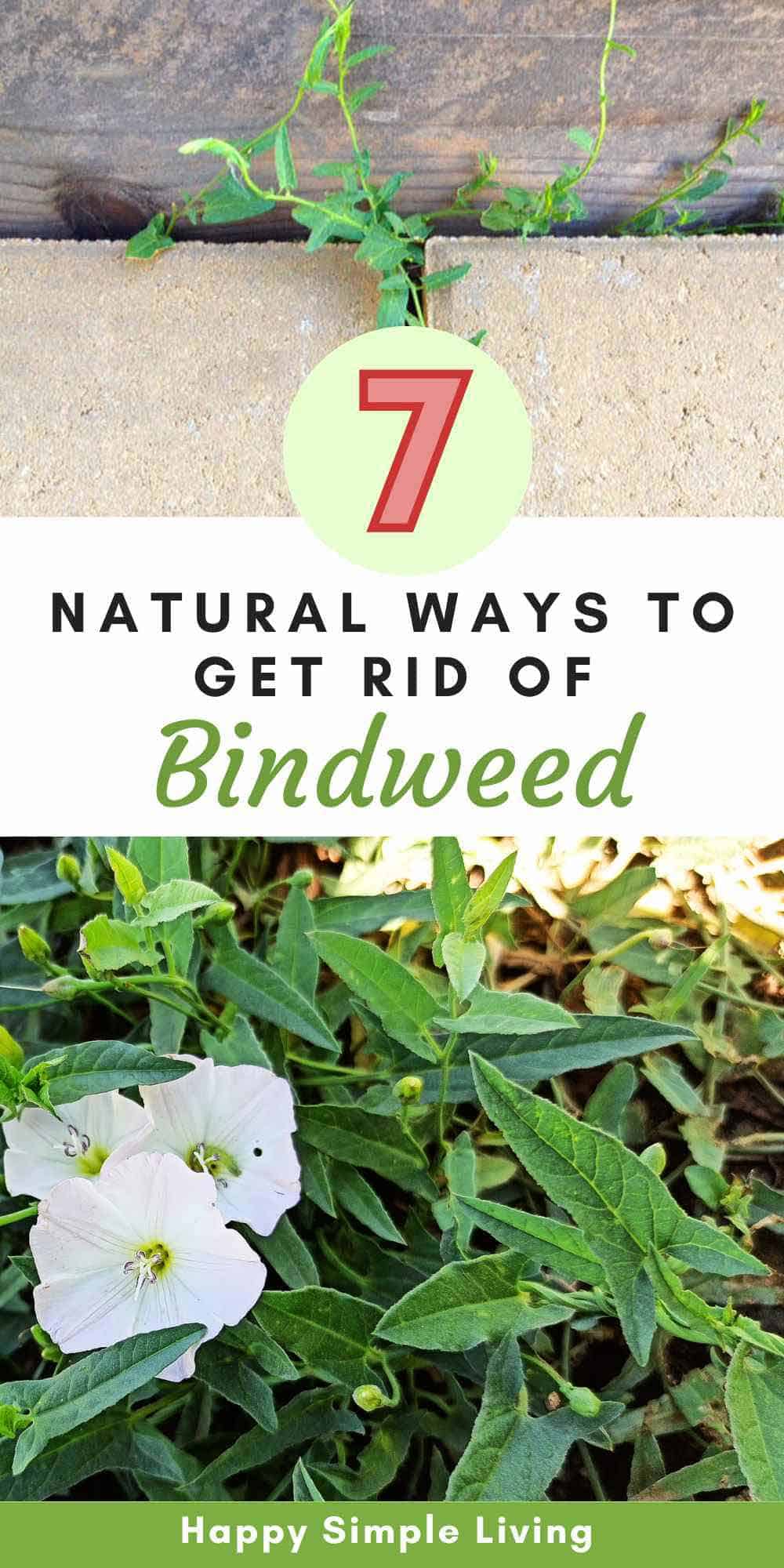
Give it the slightest little space, like the 1/4 inch gap between the raised garden and the paving stone, and it will creep in like a bad boyfriend.
What’s the deal with bindweed, anyway? Why is it such a pesky weed?
Well, garden trivia enthusiasts, allow me to share…
8 Fun Facts About Bindweed
- Bindweed has a fancy side. It also goes by the names of “Wild Morning Glory” and “Creeping Jenny.” No offense to my readers named Jenny.
- Field bindweed produces a tap root which can penetrate up to 10 feet in depth. So to get to the end of the root, you’ll simply need to dig a hole in your garden roughly the depth of a Cadillac. Is that going to be a problem?
- The multiple roots that grow laterally from the tap root can extend as far as 30 feet. To put this in perspective, imagine George Clooney, Brad Pitt, Henry Cavill, Jon Hamm and Gerard Butler lying head to toe in your garden.
- Bindweed can serve as a host for several viruses that affect potatoes, tomatoes and other crops.
- As you probably know if you’ve tried to pull it, bindweed stems break easily. When fragmented, the underground plant parts will produce new, adorable little infant plants.
- One plant can produce as many as 14 precious little shoots in one year, each of which grows 1 ½ to 4 ½ feet in the first season.
- Each plant is capable of producing 25 to 300 cute little seeds.
- Due to an extremely hard seed coat, the seeds can remain viable in the soil for up to 50 years. It’s sobering to realize that my bindweed seeds will likely outlive me.
Whew, that’s one feisty weed. So naturally, I wondered if this tenacious weed could have any lovable qualities.
If you share the view that each and every living thing on earth has its place and purpose, you’ll probably smile when you read about one of bindweed’s most important roles. Allow me to present:
1 Cuddly Fact About Bindweed
- Amazingly, a major anti-cancer drug is derived from bindweed. I am not making this up.
Which is why I’ve generously opened our back yard to all scientists who need more bindweed samples.

That’s just the kind of selfless, philanthropic person I am.
Aside from finding willing takers or digging to China to reach the end of your bindweed roots, what’s an organic gardener to do?
Two readers asked for my advice about dealing with bindweed on my frugal gardening post How To Avoid $100 Tomatoes, and I’m glad they did because it made me feel, for a few moments, like Dear Abby or Dr. Phil. My readers think I know about such things! I thought to myself.
It was a delicious moment that ended too soon after I decided that I, a Gardening and Weed Expert, should probably go water my parched garden. Which is when I discovered that a new plant had quietly begun its sneaky, determined climb to overtake the garden faucet.

Time’s a-wastin,’ my friends, and your bindweed has probably grown another ten feet while you’ve been reading this blog post. So without further adieu, I present you with:
7 Natural Ways to Control Bindweed
- Discourage it young. Young seedlings can be destroyed when cut several inches below the soil. Whatever you do, don’t wait until the weeds are pre-teens.
- Get heavyhanded with mulch. Bindweed likes sunshine, so mulch can discourage it.
- Till it. Hoeing, digging, or tilling more mature field bindweed every one to two weeks for several seasons can reduce plant vigor.
- Torch it. Some gardeners have had luck zapping bindweed with a weed torch, which sounds kinda fun. It’s a propane tank with a little torch that burns up the weed.
- Attack it. My sister, who has a small farm and very green thumb, told me about bindweed mites – blessed little bugs that eat the plants. Some states have programs where you can obtain the mites for free; check with your county extension office.
- Fry it. Our reader Eileen has a unique way of dealing with the weed. She reports: ”I push short lengths of garden cane into the soil next to the shoots and wrap the stems around the canes. This stops the bindweed from entwining itself around other plants. I then cut off the bottom of 2 liter plastic water (or juice) bottles and remove the cap. I pop the bottle over the cane and weed and spray into the neck of the bottle with a concentrated salt mixture. I then replace the cap. Before you know it the plant has shriveled and died as the heat in the bottle ensures the salt burns it very effectively.”
- Carefully douse the plant it in boiling water. This is the method used by some professional large scale weed removal services.
Bonus tip: Embrace your bindweed. Train it to grow on topiary forms, and tell your neighbors it’s your prized Creeping Jenny.

While bindweed is a constant challenge, I’ve taken a different view about the yellow dandelions that sprout up in our yard and provide pollen for the bees. You might enjoy this dandelion history lesson, written from the future.
How about you? Is bindweed a problem in your garden, and have you found an organic way to control it? Drop a comment below!
Happy hoeing from your Gardening and Weed Expert!

Eliza Cross is the creator of Happy Simple Living, where she shares ideas to help busy people simplify cooking, gardening, holidays, home, and money. She is also the award-winning author of 17 cookbooks, including Small Bites and 101 Things To Do With Bacon.




Thank you for one of the most delightful posts I have ever read. Having dealt with bind weed, it was good to laugh and get some excellent suggestions. As someone who prefers the easiest possible organic approach, the mites and Russian tortoise sound fantastic!
I enjoyed reading the comments here so much!! I have 2 acres of bindweed. Here are the things I have tried: roundup–I have used roughly 30 gallons of roundup and bindweed is STILL thriving. It works briefly. Ground Clear kills it, but you can’t grow anything there for a year or more. Tilling–what a giant mistake that was. A neighbor told me to till, so I did and so did my neighbor. Every single little piece of that tilled weed made new ones sprout. It made the problem worse. Then I read that yes, you can till it out if you till every 2 weeks FOR 5 YEARS!! Landscape fabric–they just grew along underneath until they found an opening. Cardboard–same as the landscape fabric. Vinegar–different strengths, temperatures, with soap, with salt and whatnot–didn’t even make it turn brown. Boiling water–just made them happy. The ONLY thing that I have had luck with is 2,4-d–the active ingredient in Weed B Gone. You have to do due diligence with it too, but it works. It is used on pasture grass to control weeds and won’t harm your lawn. I don’t use it around my flowers or veggies at all though. The weed burner works. The heat makes the cell structure burst–3 seconds on each plant. It is not a good choice for large areas though because propane can get quite expensive. There are weed torches that use the little 1 pound bottles that are light and concentrate the heat in a small space. I would suggest the investment in one of those if you are going to try it. The large burners that attach to your propane tanks have big flames and go through a bottle of propane in short order. The state agricultural school did not return my calls for the bindweed mites. They have not published any articles about it for several years that I could find. People I know that tried them had some success, but they are (apparently) difficult to get in NM. I have read that the mexican sunflowers really work but are also very hard to kill off. At least they are quite pretty. I have read from a number of people that said planting pumpkins has been very successful for helping control bindweed. I tried that this year, but the squirrels ate my pumpkin plants (and have been stealing my watermelons!). I don’t like the idea of spraying down my whole place with 2,4-d, but it really seems to be the best thing to get it under control so that some of the other options are viable for maintenance. So…that is my experience with bindweed and some of the remedies for it. I might have to check into getting some of those turtles……
Where we live Creeping Jenny is a completely different plant. A quick google search will show you this. Im not sure if thats a name someone in your area gave the plant, or mistakenly identified it. But you should look it up, because creeping jenny here is not an invasive plant. It does serve as a ground cover and spreads but not invasive (no 30 year seeds, etc)
Thoughts?
You are 100% right, Jen. In fact, I have some of the pretty Creeping Jenny plant you’re referring to. Its Latin name is Lysimachia nummularia, and it’s a non-invasive groundcover here in Colorado. The other Creeping Jenny’s Latin name is Convolvulus arvensis, also known as bindweed (also known as the plant that makes some of us cuss and holler while we’re digging and yanking!)
I have started calling it Borg weed after the Star Trek aliens because your garden/yard will be assimilated, and resistance is futile. A neighbor told us about bind weed gall mites. So I was doing some research. Thanks for your post. Oh and bind weed makes good chicken feed. We feed them buckets full of it in addition to their regular feed.
hahaha! lOVE everyone’s sense of humour on here! Thanks for the great tips… and the smiles! :-) Patti
so glad to learn there are so many other bind weed sufferers. I am about to try another battle with this green beast. Thanks all for making me smile as I go to pull bindweed for yet the 4th time this year…. it is the project that never never ends. At least I am smiling today!
“The project that never ends” – ha! Made me laugh. I guess it keeps us out of trouble, right, Cyndi?
I read where boiling water would kill the bind weed. Could you not just use the hot water from the wash machine spigot and run a hose to the garden?
Splendid idea, Marilyn – will you let us know if you have any success?
Hi! from Northern England – I re-married 17 years ago and my new wife when looking at my garden saw that I had Bindweed and warned me of the consequences. I laughed this off and told here she made it sound like ‘Day of the Triffids’ and now in October 2016 it certainly looks like it and I am currently battling to get ride of it?! It’s even growing up and inside my garden shed – I’ve tried digging it out, weed killer and now I might try the vinegar idea (seems to be a remedy for everything!) Driving me crazy?!
For those growing bindweed as a tea, food or scented ornamental be aware that just about every state in the US has every form of it listed as a noxious weed. That means it’s illegal to let it grow. As a strict organic gardener I’ve used highly concentrated vinegar, orange concentrate and salt in the sun to control it. After 30 years in one garden I was able to stave off large areas but there are certain patches that remain that must be dealt with.
Yes it is a noxious weed where I live, and if we don’t control it along our fence lines and on our alley sides, the city “Noxious Weed Control” people come along, and recommend us for fines.
What is “orange concentrate”, where do you get it, and how do you use it?
Do you use regular white vinegar, full strength?
“Salt”, is that rock salt, Epsom salt, or regular salt? How much and how often is it applied, and with or without water?
Please can you give more details about the orange concentrate. Essential oil? What sort of quantity of salt and oil and vinegar? Did you brush that on the leaves? I would love to hear more detail., how long did it take to work?
One year I thought it was pretty so let it grow, it does not need much of an invitation to go mental and take over ( combined with huge clumps of sedge and creeping lawns into the flower beds, there was not much space for the poor flowers). . There is not much left in my flower beds except bindweed roots and a couple of brave bluebells and one tulip where there were many.
Thankfully it did not extend into my veg patch on the other side of the garden. I am super greatful for that.
Has anyone had success with the cardboard and thick mulch idea? Is it best to dig most of the roots out first? Once the mulch is applied it would be really hard to dig roots again. Thanks.
Well, our block just got letters from the Weed Patrol about our bindweed problem. We, personally, use a lawn service that has worked wonders for our bindweed problem, but neighbors on both sides of us are having to face the problem now. I have heard that pouring boiling water on the plant can kill it. Has anyone had any luck with that? I see that someone above mentioned putting dish soap with it. Or vinegar? We have a time limit to getting rid of these weeds, so any information to get this weed taken care of quickly will be very much appreciated!
Such a fun blog! I have bindweed everywhere…garden, yard. Would like to try the mites. Thanks for adding a bit of humor to a humorless plant.
Thank you, Suzanne. I envision a future when we will get compensated for our impressive bindweed specimens. Until then, we bindweed growers have to stick together! xo
0 do.I
I have a lot of it but now 75 and arthritic it takes me a while
Where would I get the mites
Chm88858@gmail.com
It is almost worth having bindweed- otherwise I would not have read your blog :)
Thank you, Julie – your comment made me smile. Good luck with the Battle of the Bindweed!
I am experimenting with Tagetes Minuta (Mexican Marigold) which apparently has roots which exude a chemical toxic to bindweed – I have grown the plants from seed and am waiting for a sunny day (here in the UK that’s quite rare!) to plant them out. I had a good go at the shrub beds at the weekend and got as much root as I could out – it looked like spaghetti there was so much of it! Am hoping now the roots are a bit damaged they might succumb more readily!
What an interesting idea, Philippa. If you have any luck with your experiment, we’d all love to hear back from you.
did the taggetes work? They r back with a vengance this year,but am going to try white vinegar. I prefer a natural remedy if possible,but my son just bought a weed burner from wilkos for about £8 minus gas ,so that may be on the agenda too!.
I am thinking of putting hogs to dig up the roots?
Oh Carla, if you enlist swine to dig your bindweed will you please please please send photos? xoxo
Carla Inman-Martin, It is now Oct. 8, 2017. Did you have any luck putting the hogs to digging up the roots?
I am trying to cover it with card board. We get a lot of heavy card board. I have tried the boiling water with dish soap to make it stick. It kind of worked.
My neighbour covered here garden patch with several layers of cardboard last year. And it appears to have the problem under control. Not just the bindweed, but ALL weeds.
I tried garden fabric cloth a few years ago. But the bindweed roots grew underneath it “very well” and continued growing until they reach the light. I’ve had bindweed roots that were so long, I could have used them as string…lol! (Easily 10 feet long, growing under the garden fabric.)
Thank you for your advice, Eliza. I’d like to find those Bindweed Mites. The local Canadian Master Gardeners have never heard of them (here in London, Ontario). Do you know if they will work in my cold climate? Are they available anywhere in Canada? Or can they be ordered from the USA? Bindweed is all over my yard, in the grass and garden beds.
I use Bindweed Mites here in Colorado. I suggest searching for an Insectory in your area – we have one here in Colorado, and every year I pay about thirty bucks to have some mites delivered in the fall. They seem to keep it down to a much more manageable level than I had before I used them. And they survive the winters here in the 5a zone I am in.
Control bindweed?
HAHAHAHAHA
Dust off and nuke it from orbit, it’s the only way to be sure.
Hahahaha, I share your view! Too funny, Geni.